| . |
The eastern tent caterpillar (Malacosoma
americanum)
(Lasiocampidae)
| Overview |
| Shelter Building |
| Thermoregulation |
| Anti-Predator Defense |
| Trail Making and Recruitment |
| References |
In terms of complexity of
interactions,
eastern tent caterpillars stand near the pinnacle of caterpillar
sociality.
The adult moth lays her eggs in a single batch in late spring or early
summer. Oviposition is limited to cherry, apple and a few other
rosaceous
trees. The egg masses contain on average 200-300 eggs. Embryogenesis
proceeds rapidly and within three weeks fully formed caterpillars can
be
found within the eggs. But the small caterpillars lie quiescent
until
the following spring, chewing their way through the shells of their
eggs
just as the buds of the host tree begins to expand.
The newly hatched caterpillars
initiate
the construction of a silk tent soon after emerging. The
caterpillars
typically aggregate at the tent site for the whole of their larval
life,
expanding the tent each day to accommodate their increasing size. Under
field conditions, the caterpillars feed three times each day, just
before
dawn, in the evening after sunset, and at mid afternoon. During each
bout
of feeding the caterpillars emerge from the tent, add silk to the
structure,
move to distant feeding sites en masse, feed, then return immediately
to
the tent where they rest until the next activity period. The exception
to this pattern occurs in the last instar when the caterpillars feed
only at
night. The caterpillars lay down pheromone trails to guide their
movements
between the tent and feeding sites. The insect has six larval
instars.
When fully grown, the caterpillars disperse and construct cocoons in
protected
places. The adults emerge about two weeks later. Mating and
oviposition typically occur on the same day as the moths emerge from
their
cocoons and being completely spent the females die soon thereafter.
The tent of the eastern tent
caterpillar
is among the largest built by any tent caterpillar. The tents are
constructed
in the crotch of the host tree and are typically oriented so that the
broadest
face of the structure faces the southeast, taking advantage of the
morning
sun. The caterpillars typically add silk to the structure at the
onset of each of their daily activity periods. Silk is added
directly
to the surface of the tent as the caterpillars walk back and forth over
the surface of the structure.The
silk is laid down under slight tension and it eventually contacts,
causing
the newly spun layer of silk to separate from the previously spun
layer.
The tent thus consists of discrete layers separated by gaps within
which
the caterpillars rest.
The tent has openings that
allow
the caterpillars to enter and exit the structure. Openings are
formed
where branches jut from the structure but are most common at the apex
of
the tent.
Light has a great effect on the caterpillars while they are spinning
and
they always spin the majority of their silk on the most illuminated
face
of the tent. Indeed, if under laboratory conditions the dominant
light source is directed at the tent from below, the caterpillars will
build their tent upside down. Caterpillars continue to expand
their
tent until they enter the last phase of their larval life. The
sixth-instar
caterpillar conserves its silk for cocoon construction and adds nothing
to the tent.
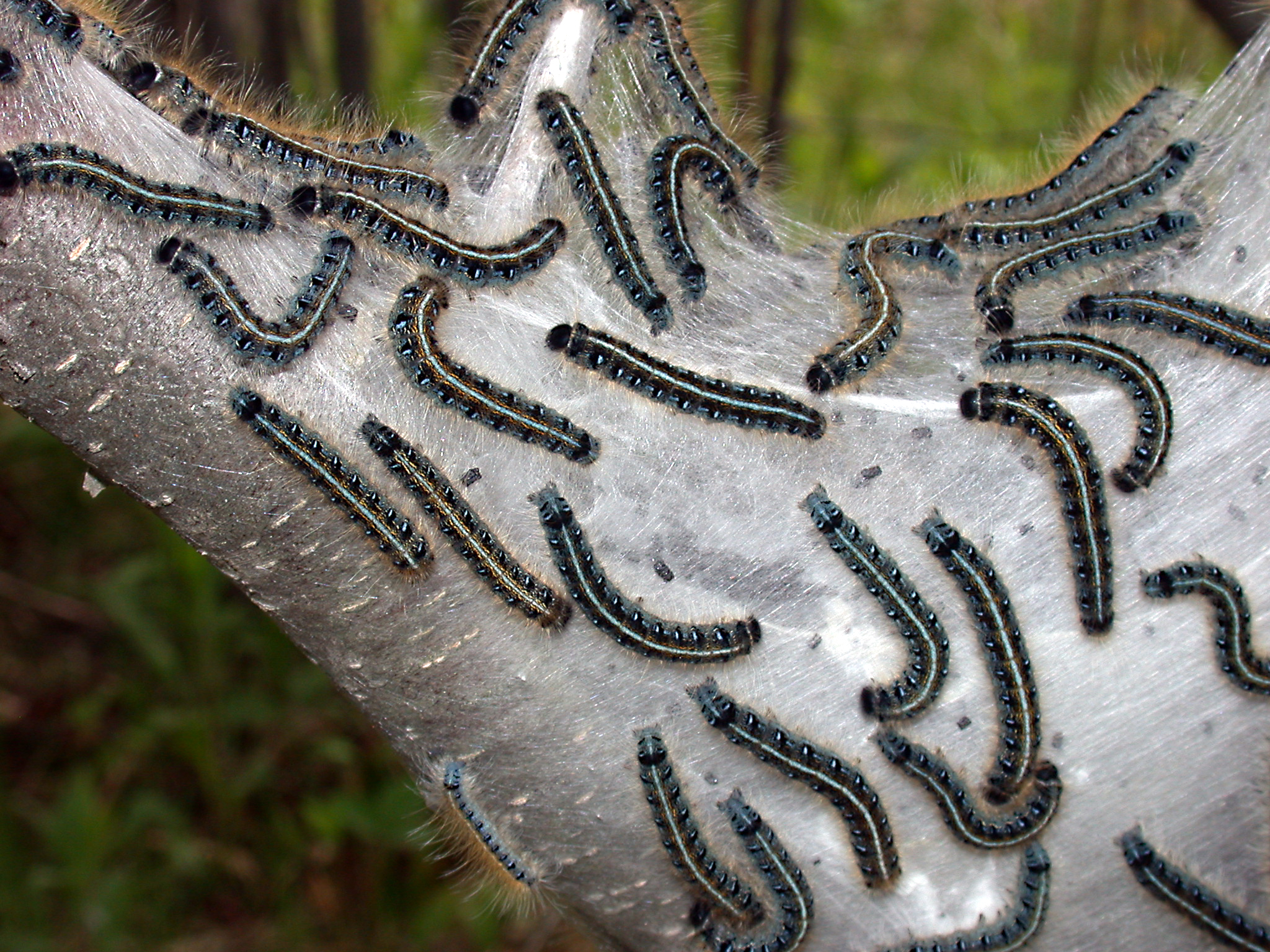
The tents appears multifunctional. They facilitate basking, offer some protection from enemies, provide for secure purchase, and act as a staging site from which the caterpillars launch en masse forays to distant feeding sites. The elevated humidity inside the tent may facilitate molting.
Heliothermy
-
Eastern tent caterpillars are among the earliest of caterpillars to
appear
in the spring. Because the early spring weather is often cold, the
caterpillars
rely on the heat of the sun to elevate their body temperatures to
levels
that allow them to digest their food. Studies show that below 15oC
(59o F)
the caterpillars
are unable to process the food in their guts. Early instars of the tent
caterpillar are black and their bodies readily absorb the rays of the
sun.
When basking, the caterpillars typically pack together tightly,
reducing
heat loss due to convective currents. The long setae that occur
on
the caterpillars also serve to stem convective heat loss. The
caterpillars
may aggregate on the surface of the tent or within the structure.
The tents act as miniature glass houses, trapping the heat of the
morning
sun and allowing the caterpillars to warm more quickly than they would
if they remained outside the tent. Studies have shown that
basking, aggregated caterpillars can achieve temperature excesses (Tbody-Tambient)
of as much as 44oC.
Indeed, the caterpillars can easily over heat and they must take
evasive
action when they become too hot.
Because
of its layered structure, the tent is thermally heterogeneous and the
caterpillars
can adjust their temperature by moving from layer to layer. The
caterpillars
may also aggregate on the outside of the shaded side of the tent and
hang
from the tips of their abdomens to enhance convective heat loss and
cooling.
Metabolic heat trapping - As shown for other caterpillars the later instars of eastern tent caterpillars are capable of generating a small amount of metabolic heat while they digest their meals. When recently fed caterpillars pack tightly together, the temperature of the caterpillars in the interior of the mass may be several degrees Celsius above ambient temperature even in the absence of a radiant heat source. It is unclear whether this small heat gain has a significant effect on the rate of caterpillar growth.
Tent caterpillars, like many
other
species of social caterpillars, vigorously trash the anterior part of
their
bodies when they detect predators and parasitoids. Such bouts of
thrashing, which may be initiated by a single caterpillar, radiate
rapidly
though the colony and may result in group displays involving dozens of
caterpillars. Such displays create a moving target for tachinid
flies, wasps and other small parasitoids that lay their eggs on or in
the
body of the caterpillar. They also clearly deter stink bugs and
other
timid predators.
Groups of caterpillars resting on the surface of the tent constitute aposematic displays. Few birds other than the cuckoo find the hairy caterpillars palatable. The leaves of the cherry tree are cyanogenic and the caterpillars regurgitate cyanide ladened juices when disturbed.
Tent
caterpillars secrete silk from a spinnert wherever they go and
frequently
used pathways soon bear conspicuous silk trails. As the
caterpillars
move about the tree, they largely confine their movements to these
trails.
Curiously, it is not the silk that they follow but a trail pheromone
secreted
from the posterior tip of their abdomen. Caterpillars deposit exploratory
trails by dragging the tip of their abdomen as they move over the tree
in search of food. Caterpillars that find food and feed overmark
the exploratory trails they follow back to the tent, creating
recruitment
trails. Recruitment trails are much more
attractive
to the caterpillars than exploratory trails and they serve to lead
hungry
caterpillars directly to the newest food finds. It is possible for a
single
successful forager to recruit the entire colony to its food find.
Chemical
analysis indicates that 5b-cholestane-3-one
is an important component of the trail pheromone of the eastern tent
caterpillar.
Caterpillars readily follow trails of the synthetic pheromone,
even
leaving their own authentic trails in favor of artificial trails
prepared
with the compound.
Fitzgerald, T. D. 1995. The
Tent
Caterpillars. Cornell University Press, Ithaca, 303pp.