All these Projects and Programs are explained in detail further down in this document.
El Proyecto Juarez-Lincoln-Marti, que por sus objetivos educacionales podria haberse llamado Sierra-Dewey-Luz Caballero ha estado, durante XXX anos, completamente dedicado a proveer programas y oportunidades para mejorar la Educacion en Iberoamerica. Encontraran Reminisencias de sus veinte anos de intenso trabajo en estas paginas.
Para lograr sus objetivos, el Proyecto ha desarrollado, a traves del tiempo, los siguientes programas:
Estos proyectos y programas estan descritos en detalle, en el resto de este documento.
Sitios de Informacion sobre Coronavirus en la Red:
Incluimos a continuacion una lista de Boletines Electronicos Trimestrales del Proyecto JLM, enviados desde Enero del 2010.
Tambien, el mas reciente Boletin Electronico del Instituto Inter-Americano de Estadistica IASI.
El Director del Proyecto JLM, Dr. Jorge L. Romeu, es un Educador cubano, miembro del Fulbright Speakers Specialist Roster, a traves del cual ha dado multiples cursos y talleres en la Universidad Veracruzana, la UNERG de Venezuela, UDLA-P, Puebla, Mexico, Universidad Catolica de Sto. Domingo, Rep. Dominicana, y el Instituto Politecnico de Quito, Ecuador. Estos cursos y talleres son sufragados por la organizacion Fulbright. Las instituciones interesadas en la participacion del Dr. Romeu en cursos de su Especialidad pueden contactar a la Fulbright, al Attache Cultural de la Embajada de EEUU, o al Dr. Romeu directamente, enviandole un email: matresearch@cortland.edu
The Juarez Lincoln Marti Project Director, Dr. Jorge L. Romeu, is a Cuban Educator, member of the Fulbright Speakers Specialist Roster, through which he has taught courses in several universities, including Veracruzana, Mexico, UNERG University, in Venezuela, UDLA-P, Puebla, Mexico, Universidad Catolica, Dominican Republic, and Instituto Politecnico, Ecuador. Such courses and workshops are subsidized by the Fulbright organization Those instituciones interested in having Dr. Romeu for up to six weeks, teaching one of its courses can contact either the Fulbright Roster, the US Cultural Attache, or him directly, via his email: matresearch@cortland.edu
El Proyecto JLM mantiene una pagina internet bilingue con materiales de estadistica aplicada e ingenieria de la calidad, con aplicaciones industriales: INSTITUTO DE ESTADISTICA APLICADA Y MEJORA CONTINUA (IEAMC). Los materiales tecnicos de dicho Instituto, que puede accederse a traves del Link: IEAMC , estan descritos en detalle en un reciente documento . Las importantes razones para la creacion de tal Instituto, asi como la forma de operarlos, y algunas consecuencias, son discutidas en una ponencia del Simposio FTC.
The JLM Project has inaugurated a bilingual Web Page, with applied statistics and quality engineering materials: the Quality, Reliability and Continuous Improvement Institute (QR&CII), that can be accessed in the QR&CII The materials included in the Institute Web Page are detailed in the following document . The reasons for creating such applied statistics Institutes, their operation modes, and some important consequences are found in an FTC paper.
El Dr. Arturo Ruiz-Falco, profesor y consultor en Madrid, Espana, ha facilitado al Proyecto JLM varios materiales, utilizados en sus curso de estadistica industrial (education materials facilitated by Prof. Arturo Ruiz-Falco): Control Estadistico de Procesos; Diseno de Experimentos DOE; Costes de Calidad COPQ; Introduccion al SeisSigma; Quality Function Deployment QFD; Analisis de Varianza ANOVA-I; Herramientas para Calidad; Comparacion de dos Muestras Student t; Muestreos de Aceptacion;
El Prof. Jorge Luis Romeu, de la Universidad de Syracuse, tambien ha facilitado materiales de sus cursos de estadistica industrial (education materials by Prof. Romeu): Syllabus del curso de Diseno de Experimentos; Syllabus del curso de Simulacion; Syllabus del Seminario Profesional de Simulacion; Algunos problemas de la educacion estadistica en cursos de Ingenieria Colloquium; y Formacion de Profesionales Internacionales IberoAmericanos
El Dr. Jorge Luis Romeu ha facilitado, EN INGLES, veintidos tutoriales para un curso avanzado de estadistica industrial; dos tutoriales: uno sobre analisis secuencial y otro sobre la determinacion de los tamanos de muestra adecuados, asi como el diseno de un curso completo de estadistica industrial, utilizando metodos de simulacion
El Prof. Javier Gomez-Martinez ha facilitado el Diccionario Abreviado de Matematicas de Oxford
El Dr. Ron Kenett, de KPA Ltd. y Samuel Neaman Institute, Israel, ha facilitado el articulo "Election Polls: a Survey, Critique and Proposals", que analiza los surveyes politicos.
Sometemos un cuestionario sobre la utilidad que Ud. encuentra en nuestra pagina web tecnica IEAMC. Agradeceremos que lo llene y mande, a nuestra direccion email: matresearch@cortland.edu.
PROYECTO PARA AYUDAR A MEJORAR LA EDUCACION ESTADISTICA APLICADA Y LA FUNCION DEL MAESTRO. Entre Octubre del 2011 y Junio del 2012, trabajamos en la oficina de Investigacion de la Facultad (Sponsored Research) del SUNY Institute of Technology, desde donde desarrollamos planes, utiles para ayudar a nuestras instituciones a desarrollar mas ampliamente su investigacion, ademas de desarrollar otros temas de pedagogia general y estadistica, de evaluacion de alumnos y de creacion de programas que atraigan mas estudiantes a carreras de ciencias e ingenieria.
PROYECTO PARA DESARROLLAR MAS PUBLICACIONES DE ESTADISTICA APLICADA EN ESPANOL. RCE, la Revista Colombiana de Estadistica, publico sobre este tema, en el verano de 2011, un numero Especial. Su pagina en red esta en Internet. La revista Trimestral de IASI, el Instituto Inter Americano de Estadistica, tambien publica articulos en Espanol e ingles sobre aplicaciones estadisticas. La revista de SOCHE, la Sociedad Chilena de Estadistica, tambien ha publicado excelentes articulos sobre aplicaciones y educacion estadisticia, en ingles, que pueden encontrar en su pagina del Internet. La revista internet Hipotesis Alternativa, boletin de IASE para America Latina, tambien publica articulos en espanol sobre Educacion Estadistica. Hipotesis resume trabajos de la revista SERJ, Statistics Education Research Journal. Su pagina internet es: Hipotesis y su revista puede leerse en Alternativa.
PROYECTO PARA ORGANIZAR UN INSTITUTO PASI/NSF SOBRE MODELACION ESTADISTICA DE PROBLEMAS ECOLOGICOS. En el 2009 se organizo un grupo de interes, que comenzo trabajos exploratorios para someter una propuesta de INSTITUTO PASI al NSF. Tras varios intercambios, el grupo reconocio que no existen todavia condiciones objetivas para someter una propuesta ganadora y que habia que comenzar por crearlas. Dichas condiciones previas incluyen la promocion y creacion de mas publicaciones de estadistica aplicada, para incentivar una mayor produccion de trabajos aplicados, sobre todo a la industria, economia y ecologia, para asi incrementar el numero de profesionales y alumnos interesados en utilizar la estadistica para resolver problemas practicos socioeconomicos. Este proyecto empalma con el que sigue abajo.
PROYECTO PARA ORGANIZAR INSTITUTOS DE ESTADISTICA APLICADA INDUSTRIA-UNIVERSIDAD para contribuir al desarrollo economico de la region. Utilizando previas experiencias en el estudio de tales problemas, de propuestas sometidas al NSF, y otras organizaciones que han acogido con interes esta idea, asi como a organizaciones profesionales. Hemos creado una nueva pagina en la red, el INSTITUTO DE ESTADISTICA APLICADA Y MEJORA CONTINUA (IEAMC), que puede accederse en IEAMC. Las razones para la creacion de tales Institutos, asi como ejemplos de sus trabajos y organizacion, se encuentran en un articulo academico. Cualquier colaboracion es bienvenida y sera reconocida como contribucion de sus autor(es).
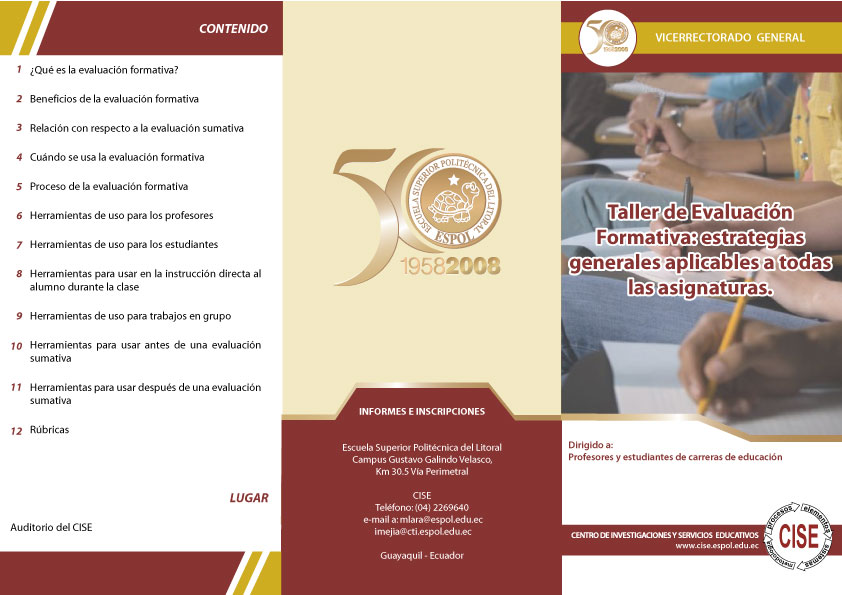
Some areas include/Algunas areas incluyen: (1) new technology Infusion and its Applications ; (2) pedagogical and methodological innovations in mathematics and science education ; (3) Simulation modeling, as educational , or (4) simulation as an Operations Research analysis tool; (4) reliability modeling and analysis ; (5) design of experiments DOE ; (6) deterministic and/or stochastic Operations Research methods ; (7) probability and statistics ; (8) industrial statistics applications ; (9) industrial quality and productivity engineering and (10) organization of academic statistical consulting institutions . The teaching experiences of the Project Director are summarized in a Paper presented at Universidad Veracruzana, Jalapa, Ver, MX, (in Spanish) during an Education Colloquium ; (11) Workshop on Course Evaluation Strategies presented at ESPOL, Guayaquil, Ecuador (in Spanish) Rubrics, and (12) Data Analysis using Minitab statistical software; and (13) UV International Workshop on Statistical Education and its Methods.
The above courses are based in the 30 years of research, teaching, consulting and practical experiences of the Project Director, and his extensive writings in applied industrial statistics. The pedagody used and course objectives are discussed in ISI-2001 .
In 1997, the Project started a faculty development program at Romulo Gallegos University, UNERG , in the Orinoco plains, Venezuela, where it developed an innovative faculty apprenticeship model. The UNERG project was sponsored by Fundayacucho, the Venezuelan government educational agency, as well as by the World Bank.
The JLM Project also strives to promote and to help develop Ibero American International Professionals that may help consolidate such stronger links between peoples of different nations and cultures, especially within our own Region. Please help us improve our work by filling and emailing us the following Survey.
The reasons for all these efforts are described in a series of Spanish and English language newspaper articles, written during our frequent stages abroad, and published in journals of the US, Mexico and Spain.
Information about Prof. Romeu's involvement in Ecological Research is available in his list of Papers, and about the Great Lakes Research Consortium, in: GLRC.
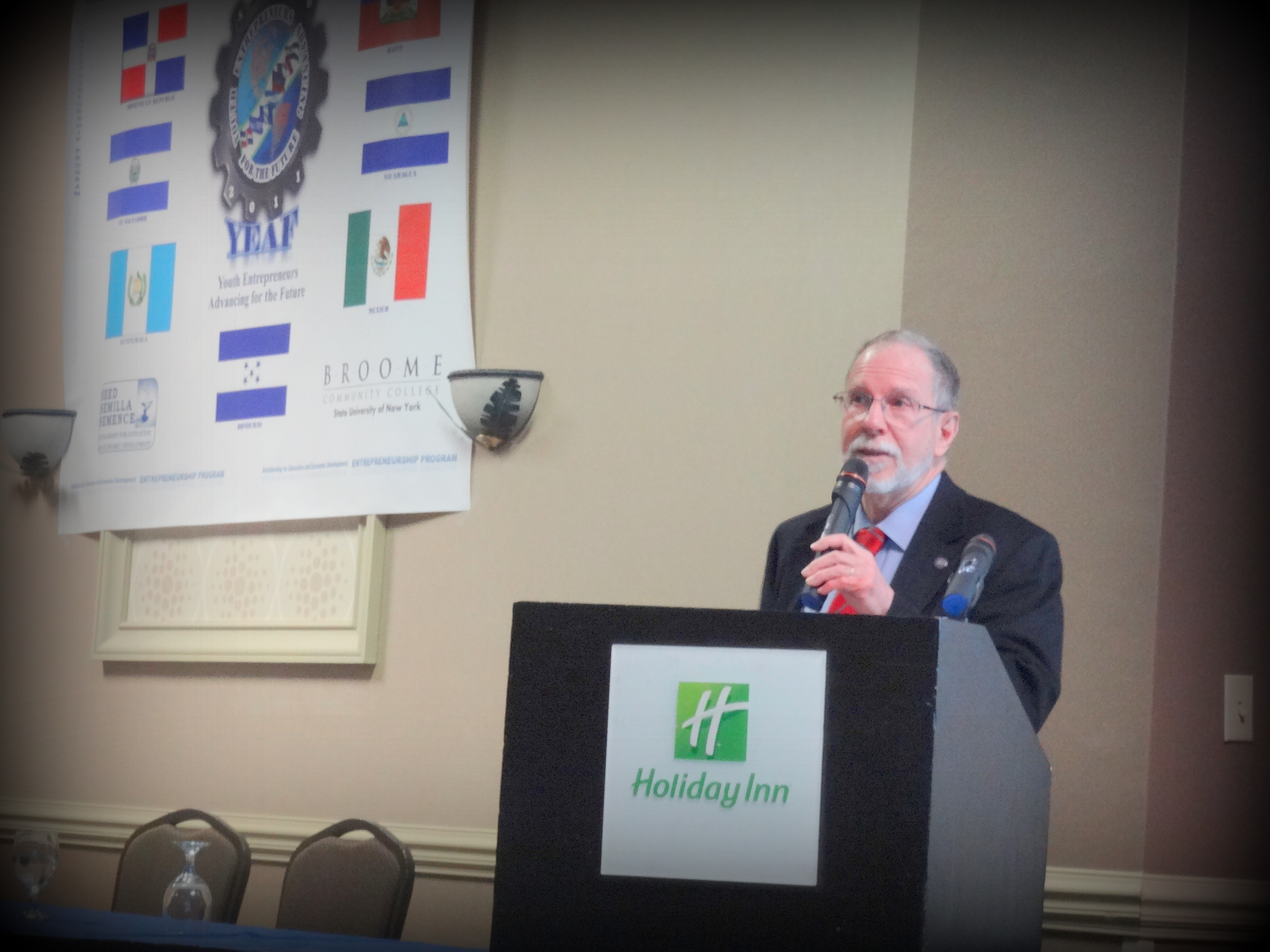
Dr. Jorge Luis Romeu, the Juarez-Lincoln-Marti Project Director, is an Academic, a Researcher and an International Educator. Romeu is a participant of both, the Fulbright Scholar, and the Fulbright Speaker Specialist Programs. As a Fulbright grantee he has received Senior Speaker Specialist assignments in Mexico (1994, 2000, 2003), the Dominican Republic (2004, June and December), Ecuador (2007) and Colombia (2020, cancelled for Covid).
For fourteen years, Romeu was a tenured, Associate Professor at the State University of New York (SUNY) College at Cortland, where he taught graduate and undergraduate mathematics, statistics and computer science courses, and was a Member of SUNY Cortland Graduate Faculty. For his work in education, for his scholarly research, for his publications and editorial work, Romeu received multiple awards and honors, and was inducted in the Gallery of Distinguished Cuban American Educators.
In December of 1998, Romeu took early retirement from SUNY, becoming an Emeritus Associate Professor. He returned to IITRI/RAC, and to research in applied statistics. At the Reliability Analysis Center (RAC), Romeu wrote many tutorials, technical papers, and taught many short courses.
In addition Romeu was, for sixteen years (2003 to 2019), a Research Professor at Syracuse University. As such, he submitted multiple research proposals to NSF and other agencies, receiving several assignments from the Rome NY Air Force Laboratory, to perform research in HW/SW Reliability, and in Design of Experiments. Romeu also taught SU graduate courses in industrial statistics and quality engineering. After retiring as Research Professor, Romeu continued teaching as an Adjunct Professor of Statistics at SU.
Romeu worked (2011-12) as a Senior Research Specialist with the Sponsored Research Office of SUNY Polytechnic Institute, formerly SUNY Institute of Technology, in Utica NY. There he also taught (2012-17), as Adjunct Professor, senior and graduate courses in Optimization Models.
Romeu is also very active in professional societies, especially in the American Statistical Association and in the American Society for Quality, where he is past Director of Region II (Upstate Pennsylvania and New York).
Romeu's academic interests (applied statistics and statistics education) are the subject of many research publications. international presentations, and Journalism. His peer-reviewed papers have been recognized with several technical Awards.
Romeu holds MS and Ph.D. degrees in Industrial Engineering and Operations Research from Syracuse University (1990), and a "Licenciado en Matematicas" degree from the University of Havana, Cuba (1973).
Romeu has lectured frequently abroad, publishing many articles about science education. He has also organized several panels on international education, and has written, published and presented many papers and research proposals on different aspects of statistics, technology infusion, assessment and administration of courses, and international education.
More recent papers, applying statistics to science and engineering, and to Covid-19 problems, with the web Hits of readers, can be found in his ResearchGate Page,
Romeu is a Cuban ex-patriate, actively involved in journalism and Cuban affairs. You can find his newspaper articles on Cuba, as well as his articles in Spanish, in English, and his opinion about the future of Post Castro Cuba.
Romeu's values, ideology and thinking have been influenced by an ancient Institution in which he is actively involved. Said influence has spurred Romeu's work in promoting, developing and improving Education, as a tool for achieving social mobility, as well as improving Civil Society through greater citizen participation.
If you want to send us a message or a comment, or if you have an idea about how to enhance or help our JLM Int'l Ed. Project, please email us to: matresearch@cortland.edu
You can also write us to: Dept. Mech. & Aerosp. Eng., 263 Link Hall, Syracuse University, Syracuse NY 13224/USA.
This Cuban Poem (in Spanish) encapsulates Romeu's life philosophy.
Thank-you for your visit!
Updated: Agosto del 2025.